Introduction
Soil erosion has become one of the most pressing environmental challenges in India and across the world. Each year, millions of tons of fertile topsoil are washed away by water or blown away by wind, reducing agricultural productivity, degrading ecosystems, and increasing the risk of floods and landslides. Traditional erosion control methods such as stone bunding, contour trenches, and retaining walls are often expensive, labor-intensive, and unsustainable in the long run.
This is where Vetiver grass (Chrysopogon zizanioides), often called the “Wonder Grass”, provides an innovative, eco-friendly, and cost-effective solution. Indigenous to India and found across the country, vetiver has been traditionally valued for its fragrant roots used in perfumes, mats, and cooling screens. But in recent decades, it has gained global recognition as one of the most effective biological methods for soil and water conservation.
This blog explores the key characteristics, establishment methods, and advantages of vetiver grass while highlighting how it solves the growing problem of erosion control in a sustainable and affordable manner.
The Problem of Soil Erosion
Soil erosion is not just about the loss of soil it impacts:
- Agriculture: Reduced crop productivity due to loss of fertile topsoil.
- Infrastructure: Roads, embankments, and slopes become unstable, leading to landslides and maintenance costs.
- Water Management: Siltation of dams, canals, and reservoirs reduces water storage capacity.
- Climate Impact: Degraded lands worsen drought and flood cycles.
Conventional measures such as masonry structures or engineering-based slope stabilization are costly and not feasible for large-scale adoption by small farmers. Hence, there is a strong need for a low-cost, low-maintenance, and sustainable erosion control system.
Vetiver Grass: Nature’s Engineering Marvel
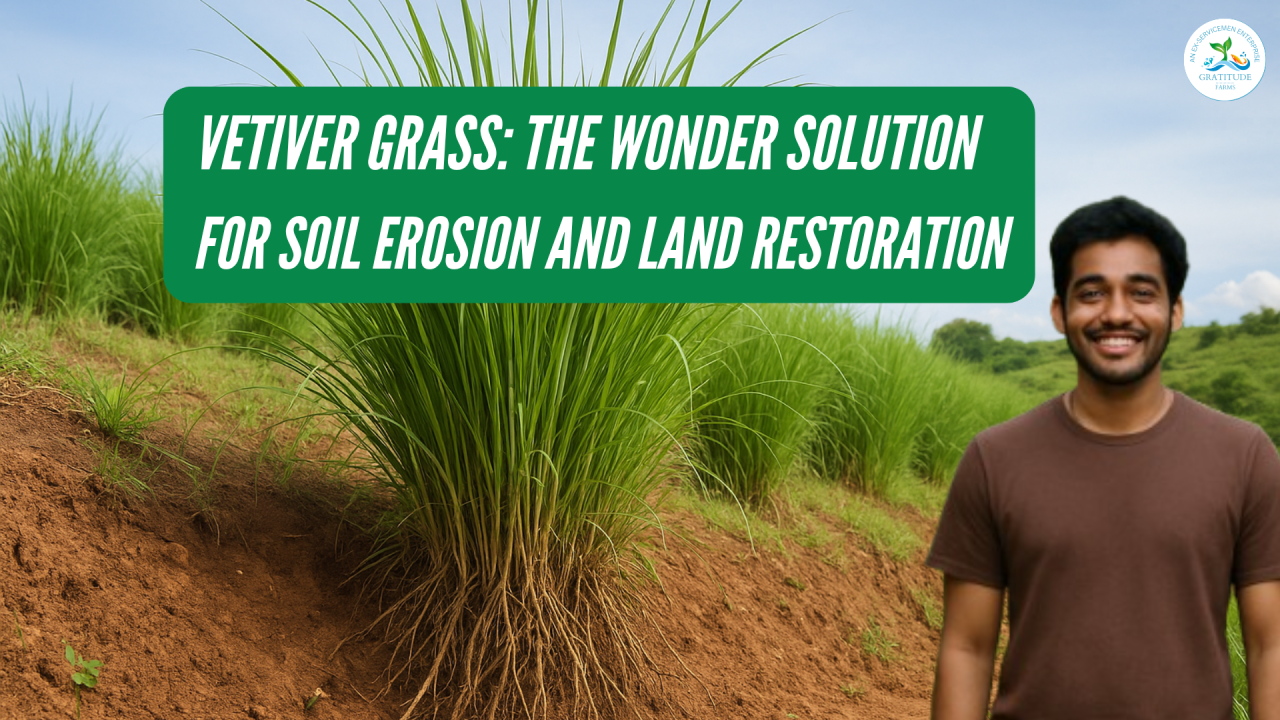
Vetiver grass provides exactly that. With roots penetrating up to 3 meters vertically, it creates a natural barrier against soil loss and strengthens the soil structure. Studies have shown that vetiver roots possess 1/6th the tensile strength of mild steel and can improve soil shear strength by 40% at 0.5 m depth.
Unlike many plants that spread laterally, vetiver grows in dense clumps and forms a hedge system that holds the soil firmly. Its adaptability makes it suitable across Indiavwhether it’s the arid zones of Rajasthan, the floodplains of Assam, or the hilly slopes of Himachal Pradesh.

Establishing Vetiver Grass for Erosion Control
One of the greatest strengths of vetiver is its ease of establishment. Here’s how it can be grown:
- Availability: Vetiver is found throughout India from North to South and East to West. If it’s not known locally, nearby botanical gardens can be consulted for its local name. It is also available in nurseries.
- Nursery Development: Vetiver nurseries can be set up easily at small dams, tanks, or gully areas where water naturally irrigates the grass. The grass also helps in filtering silt from water, making it a dual-purpose solution.
- Planting Material: Slips (root divisions) are used for planting. A clump is dug out with a spade, roots are trimmed to 10–15 cm, and tops cut back to 15–25 cm to reduce transpiration. This increases survival chances.
- Planting Method: Slips are planted in double or triple lines across slopes or streambeds. Spacing between rows is about 30–50 cm. Slips are placed 10–15 cm apart along the contour. Planting is done at the beginning of the wet season for best results.
- Maintenance: Once established, the only requirement is occasional trimming. Vetiver does not spread uncontrollably and can be removed easily if no longer needed.
Local Names of Vetiver in India
Vetiver is widely recognized across the country by different names:
- Hindi: Bala, Balah, Bena
- Urdu: Khas
- Punjabi: Panni
- Bengali: Khas-Khas
- Marathi: Vala, Khas-khas
- Gujarati: Valo
- Telugu: Avurugaddiveru, Vetiveru
- Kannada: Vettiveeru, Kaadu
- Tamil: Ilamichamver, Vettiver
- Mysore: Ramachcham, Vettiveru
- Saanthali: Sirom
- Sadani: Birni
This diversity of names underlines its deep cultural roots in India.
Advantages of Vetiver Grass for Erosion Control
Vetiver stands out due to its unique features:
- Low-Cost Solution: Establishing vetiver hedges is far cheaper compared to stone or cement structures. Farmers and communities can implement it without heavy investment.
- Minimal Maintenance: Once planted, vetiver requires almost no care. It is perennial and self-sustaining.
- Climate Resilience: Vetiver can survive in rainfall ranging from 300 mm to over 6000 mm and temperatures from 15°C to 55°C. It can even withstand six months of drought.
- Pest & Disease Resistance: Vetiver is not affected by pests or diseases, nor does it act as a host for crop pests, making it a safe companion plant.
- Deep Root System: Its fibrous roots penetrate up to 3 meters, binding soil and preventing landslides, tunneling, and cracking.
- Versatile Soil Adaptability: Vetiver thrives in clayey, sandy, gravelly, and even erodible soils.
- Eco-Friendly and Reversible: Unlike concrete or masonry structures, vetiver can be removed easily if no longer needed, leaving no permanent scars on the landscape.
Vetiver as a Problem-Solving Approach
Let’s consider a practical scenario:
- Problem: A farmer in Maharashtra is facing topsoil erosion on his sloping farmland during monsoon, reducing crop yield year after year. Constructing contour bunds or retaining walls is beyond his financial capacity.
- Solution: By planting vetiver hedges across the slope at 1–2 m vertical intervals, he creates a natural barrier that slows down water flow, traps sediments, and restores soil fertility. Within two to three years, his land is stabilized at minimal cost, ensuring sustainable farming.
This simple example shows how vetiver offers a grassroots solution to a global problem affordable, eco-friendly, and accessible to small farmers.
Broader Applications of Vetiver Grass
Beyond erosion control, vetiver has multiple uses:
- Watershed Management: Preventing siltation in dams, canals, and reservoirs.
- Highway and Railway Slopes: Stabilizing embankments and cut slopes at low cost.
- Urban Landscaping: Protecting parks, stormwater drains, and construction sites.
- Rehabilitation of Wastelands: Restoring degraded mining and quarry sites.
- Water Filtration: Vetiver hedges help in purifying runoff water by trapping sediments.
This versatility makes vetiver a powerful tool in both rural development and urban infrastructure projects.

Conclusion
Vetiver grass truly deserves its title as the “Wonder Grass”. With its deep roots, resilience across climates, low-cost establishment, and effectiveness in erosion control, it provides a sustainable answer to one of the most pressing environmental challenges of our time soil erosion.
Unlike conventional methods, vetiver offers a nature-based solution that empowers farmers, reduces government expenditure on soil conservation, and restores ecological balance.
As India faces increasing land degradation and climate stress, adopting vetiver grass systems can be a transformative step towards sustainable land management. Whether on a farmer’s field, a riverbank, or a highway slope, vetiver offers protection, productivity, and permanence all at minimal cost.
In other words, investing in vetiver grass is investing in the future of our soil, water, and communities.