From Chemical to Conscious Farming
The story of agriculture has moved through three major paradigms Chemical, Organic, and Natural each with its own promise and pitfalls.
Chemical farming was born from the industrial era, where the primary goal was to maximize yield through synthetic fertilizers, pesticides, and irrigation technologies. This system succeeded in boosting productivity but at enormous ecological cost. Over time, soil fertility declined, biodiversity collapsed, and farming became dependent on external industrial inputs.
Thanks to intensive use of chemicals, the soil-once a living organism-was reduced to a lifeless substrate for chemicals.
Organic farming arose as a corrective approach, rejecting synthetic inputs and embracing natural alternatives like compost, vermicompost, and botanical pesticides. It restored a measure of soil health and offered consumers safer, chemical-free food. However, organic farming often remained within an input substitution mindset replacing chemical fertilizers with organic ones, rather than transforming the deeper ecological relationship between soil, plants, and farmers. It also depended on external inputs, transport, and certifications, sometimes alienating small farmers.
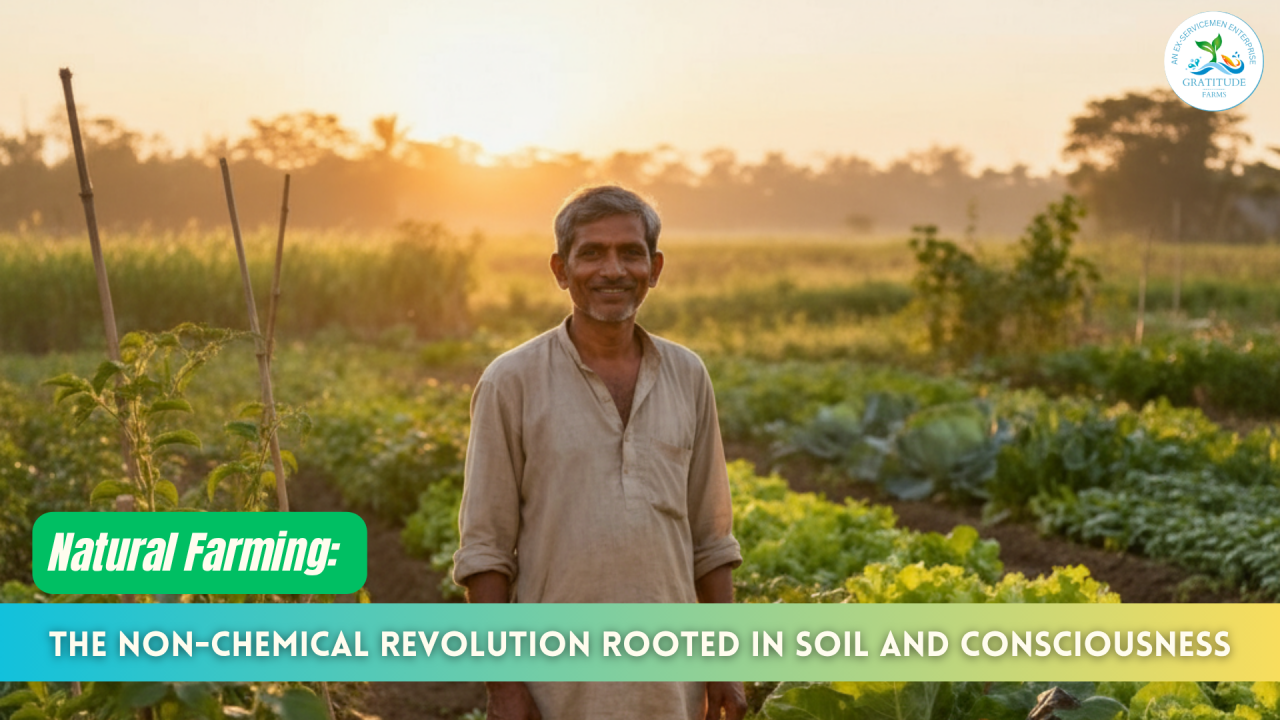
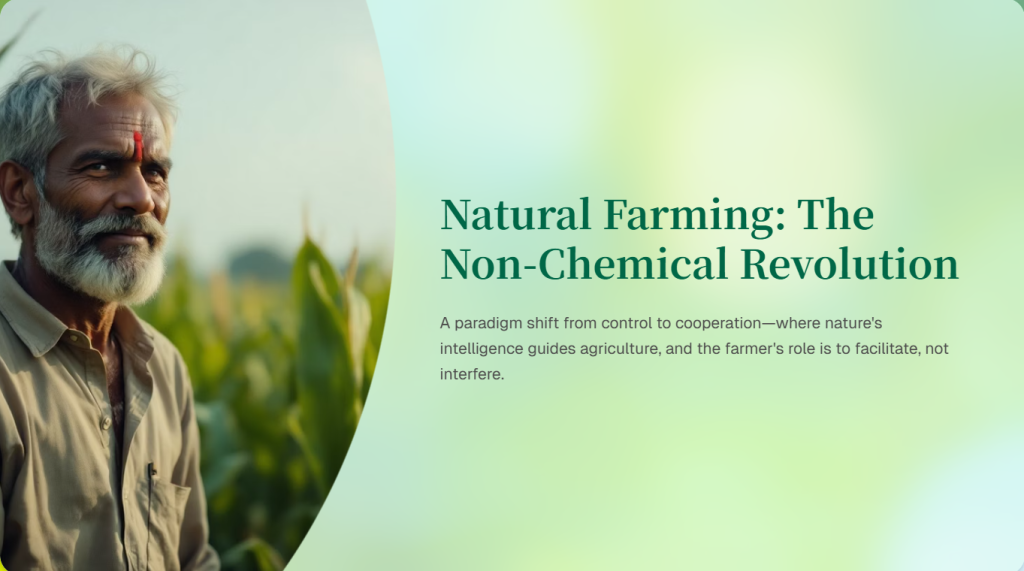
Natural Farming, in contrast, represents a paradigm shift. It transcends the input-based approach altogether. It rests on the belief that nature already knows how to sustain life, and that the farmer’s role is to cooperate, not control. It’s not merely a method it’s a philosophy of non-interference, observation, and regeneration. In Natural Farming, the goal is not to feed the plant but to feed the soil, which in turn nourishes all life.
Natural Farming is all about working with nature, not against it. The goal in Natural Farming is not to feed the plant but to feed the soil, which in turn nourishes all life.
It recognizes that nature already knows how to grow — the farmer’s role is to facilitate, not interfere.

Core Principle: Non-Chemical, Soil-Centric Farming
At its heart, Natural Farming is completely non-chemical. At its essence, Natural Farming is completely non-chemical. It rejects dependence on both synthetic fertilizers and even external organic amendments that are not farm-derived. Instead, it seeks to activate the natural fertility cycle by fostering soil microbial life, recycling farm residues, and maintaining the natural balance between moisture, air, and organic matter.
Healthy soil is treated as a living organism. Practices such as biochar enrichment, vermicomposting, green manuring, mulching, and farm-based microbial formulations like Jeevamrutam and Panchkavyam are used to enhance microbial diversity, water retention, and nutrient availability. The principle is simple: when soil life flourishes, plant health follows naturally without chemicals, without external dependence.
Different Streams and Variants of Natural Farming
Natural Farming is not a singular doctrine; it is a diverse family of practices inspired by different philosophies across the world. Each variant offers a unique window into nature’s intelligence, yet all share the same non-chemical foundation.
Subhash Palekar’s Zero Budget Natural Farming (SPNF)
Developed by Subhash Palekar, SPNF focuses on farming without external inputs or debt. Core elements like Jeevamrutam, Beejamrutam, Acchadana (mulching), and Whapasa (soil aeration) activate the soil’s natural life and strengthen its self-sustaining capacity.
Its essence is faith in nature trusting local ecosystems to nourish crops without dependence on markets or chemicals.
No-Till and Regenerative Farming
No-till farming avoids disturbing the soil through plowing, preserving natural fungal networks and soil structure. This approach enhances carbon sequestration, moisture retention, and microbial activity the foundation of resilient soil systems.
Regenerative Agriculture builds on this with principles like cover cropping, crop rotation, water management and holistic grazing all aimed at restoring soil health and reviving biodiversity.
Permaculture
Founded by Bill Mollison and David Holmgren, Permaculture is both an ethic and a design science. It organizes farms and landscapes into self-sustaining systems where plants, animals, and humans coexist in mutually supportive relationships.
“Earth Care, People Care, Fair Share” the three ethics of Permaculture beautifully align with the vision of Natural Farming.
Permaculture farms often feature food forests, water harvesting, and closed nutrient loops that mimic natural ecosystems.

Fukuoka’s “Do-Nothing” Natural Farming
The Japanese farmer-philosopher Masanobu Fukuoka articulated perhaps the purest expression of Natural Farming in his seminal work, The One-Straw Revolution. His philosophy often called the “Do-Nothing Farming” method advocates no tillage, no fertilizer, no weeding by tillage, no pesticides, and no pruning. Instead of controlling nature, Fukuoka urged farmers to observe and cooperate with it.
One of his iconic practices was the use of seed balls clay-coated seeds scattered on the ground, allowing natural germination without disturbing the soil. Fukuoka’s approach was as much spiritual as practical: he believed that agriculture should not be a battle against nature, but a dialogue of trust. His methods restored degraded lands, improved yields over time, and revealed that true abundance arises from non-interference and humility before nature.
Vriksh Ayurveda – Ancient Tree Science
Dating back over two millennia, Vriksh Ayurveda is India’s ancient text on plant health management. It prescribes natural formulations using cow derivatives, jaggery, pulses, and herbs for plant nutrition and pest resistance.
Modern Natural Farming draws heavily from this wisdom blending intuitive understanding with scientific observation. Vriksh Ayurveda views plants as living beings that respond to care, sound, and consciousness. It teaches that nurturing with love and respect can be as vital as any nutrient.
Natural Farming is not tied to one doctrine. It evolves through integration, drawing the best from multiple sources — SPNF’s microbial ecology, Permaculture’s design ethics, Fukuoka’s Natural Farming, and Vriksha Ayurveda’s conscious plant care.
At Gratitude Farms, this philosophy finds expression in a unified Natural Farming model combining science, tradition, and sustainability.
Our Integrated Natural Farming Model
Our approach focuses on maximizing soil health, biodiversity, and yield, while remaining non-chemical and self-reliant.
🔹 Soil Enrichment: Activated biochar, vermi compost, and microbial inoculants rebuild the soil carbon base.
🔹 Water Efficiency: Rainwater harvesting, mulching, and smart irrigation enhance moisture use.
🔹 Biodiversity: Mixed cropping, agroforestry, and native flora support ecosystem resilience.
🔹 Non-Chemical Inputs: Jeevamrutam, Panchkavyam, and herbal brews act as bio-stimulants.
🔹 Knowledge Synthesis: We integrate traditional wisdom with modern soil biology.
🔹 Ex-servicemen (ESM) Empowerment: We focus on developing and deploying replicable models, led by ex-servicemen from Indian Army – to make highly effective “Biochar Enriched Compost” that is used by local farmers to adopt Natural Farming.


Beyond Practice: A Philosophy of Life
Natural Farming is both ecological and spiritual. It invites farmers to observe, adapt, and co-create rather than control. It turns agriculture from an extractive act into a regenerative dialogue with the Earth.
It is not anti-science, but post-industrial science grounded in ecological intelligence and emotional awareness.
Towards a Non-Chemical Future
The future of food security lies not in synthetic precision but in nature’s quiet resilience. As climate change disrupts rainfall and fertility, the answers lie beneath our feet in living soil.
Natural Farming stands today as the most evolved response to modern agricultural crisis merging ancient wisdom with ecological innovation. It offers more than safe food it offers life security, for the planet and all who depend on it.