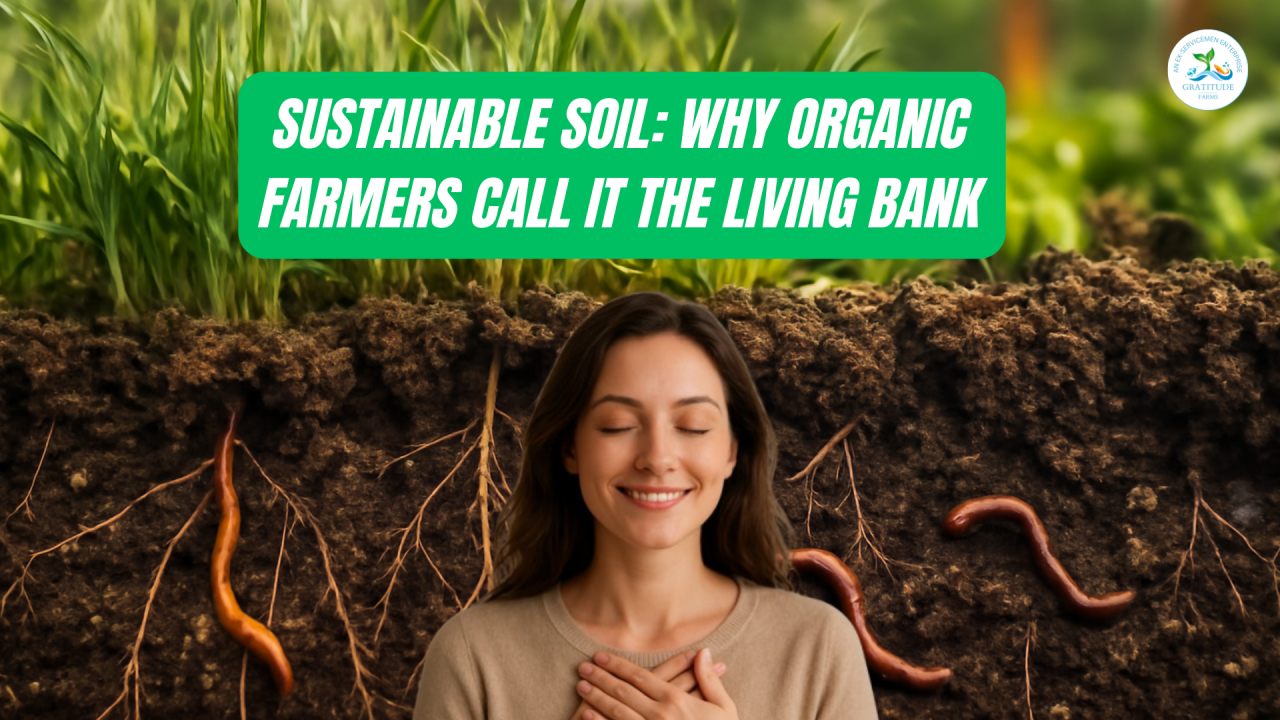
Sustainable Soil: Why Organic Farmers Call It the Living Bank
Introduction
Soil is more than just dirt beneath our feet it is a living, breathing ecosystem that sustains life on Earth. For centuries, farmers have relied on soil to grow food, but industrial practices have degraded its quality, leaving it depleted and lifeless in many parts of the world. Organic farmers, however, treat soil differently. They see it as a “living bank” a reservoir of nutrients, microorganisms, and organic matter that, if managed sustainably, can continue to yield healthy crops for generations.
In this blog, we will explore why soil is called the “living bank,” the problems caused by conventional farming practices, how organic farming provides solutions, and what steps can be taken to ensure soil remains fertile and sustainable.

The Problem: Depleting Soil Health Worldwide
Modern agriculture has delivered high yields, but at a steep cost to soil health. Some alarming facts include:
- According to the United Nations, 33% of the world’s soils are already degraded.
- Excessive use of chemical fertilizers and pesticides has destroyed soil biodiversity, leaving it sterile.
- Soil erosion causes the loss of around 24 billion tons of fertile soil every year.
This degradation poses a direct threat to food security, human health, and environmental sustainability. Without intervention, the soil the very foundation of agriculture may fail to support future generations.

Why Organic Farmers Call Soil the “Living Bank”
Organic farmers liken soil to a bank because it functions as a storehouse of resources. Just like money in a bank can grow with interest, soil, when enriched naturally, multiplies its fertility over time. Here’s why:
- Nutrient Reservoir
- Microbial Wealth
- Water Savings Account
- Long-Term Returns

The Organic Farming Solution: Building Soil Wealth
Organic farming approaches soil as a renewable resource that needs to be nurtured, not exploited. Here are the key practices organic farmers use to treat soil as a “living bank”:
1. Composting: Depositing Nutrient Wealth
Organic matter from kitchen scraps, crop residues, and animal manure is composted and returned to the soil. This replenishes nutrients naturally without synthetic inputs.
2. Crop Rotation: Diversifying Investments
Just as investors diversify portfolios, farmers rotate crops to prevent soil nutrient depletion. For example, legumes fix nitrogen into the soil, enriching it for the next crop.
3. Green Manure and Cover Crops: Interest on Savings
Cover crops like clover or alfalfa protect the soil from erosion and add organic matter when plowed back in. They act like “interest” that keeps the soil account growing.
4. Minimal Tillage: Protecting Capital
Excessive tilling disrupts soil microbes. Organic farming minimizes tillage to preserve soil structure and microbial life.
5. Natural Pest Management: Avoiding Hidden Costs
Instead of synthetic pesticides, organic farmers rely on beneficial insects and natural predators. This protects biodiversity and avoids chemical buildup in the soil.

The Benefits of Sustainable Soil Practices
When soil is treated as a living bank, the benefits extend beyond the farm:
- Higher Crop Quality: Nutrient-rich soil produces healthier, tastier, and more nutrient-dense food.
- Resilience Against Climate Change: Healthy soils absorb carbon and store water, reducing vulnerability to floods and droughts.
- Environmental Protection: Reduced chemical runoff means cleaner rivers, lakes, and groundwater.
- Long-Term Food Security: Sustainable soil practices ensure future generations will inherit fertile land.
Practical Steps for Farmers and Consumers
For Farmers:
- Start small with composting and crop rotation.
- Reduce chemical use gradually and replace with organic alternatives.
- Participate in local training on soil health and organic certification.
For Consumers:
- Support organic farmers by purchasing certified organic products.
- Reduce food waste—compost at home to return nutrients to the soil.
- Advocate for policies that encourage sustainable agriculture.
Conclusion
Soil is not an infinite resource it is a fragile ecosystem that requires care. Organic farmers call soil the “living bank” because, when nurtured, it gives back more than what is deposited into it. By composting, rotating crops, reducing chemicals, and working with nature rather than against it, organic farming ensures the soil remains rich and productive.
Sustainable soil management is not just about farming it is about securing the future of food, health, and the planet. Just like saving money for the next generation, investing in soil today guarantees prosperity tomorrow.