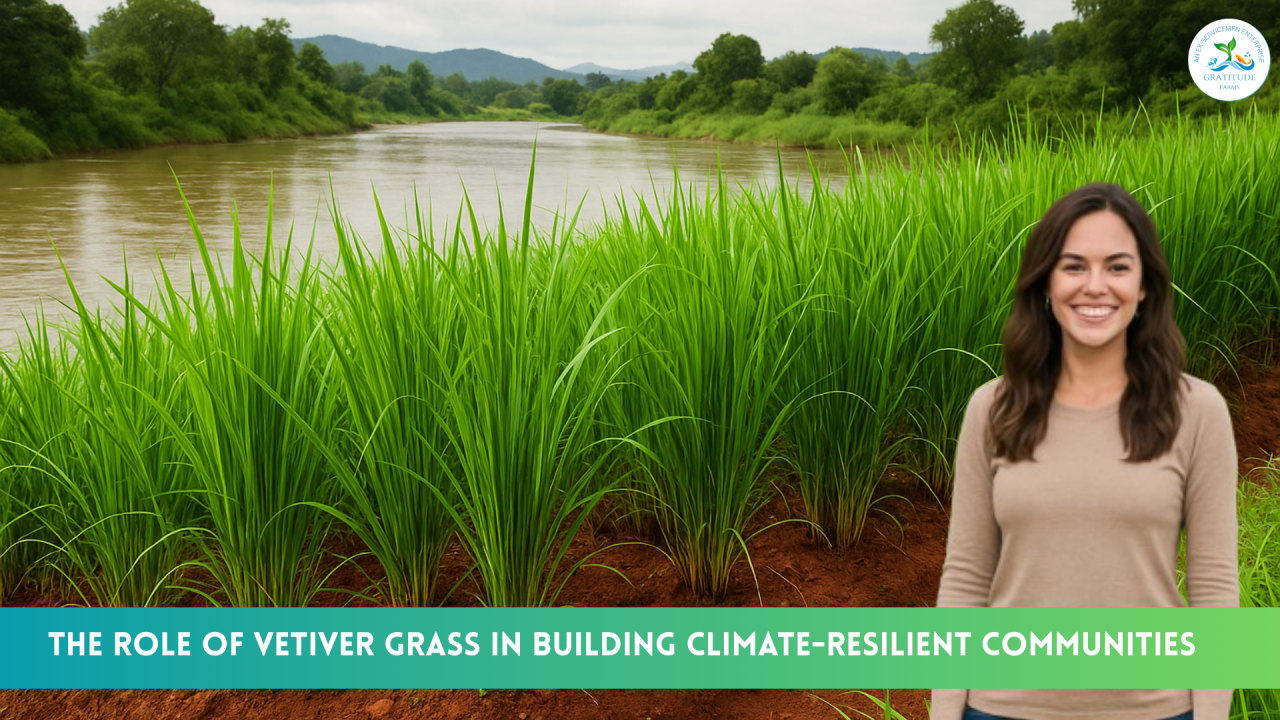
In today’s world of rising climate risks, communities across the globe are searching for sustainable, cost-effective, and eco-friendly solutions to safeguard their livelihoods. One such solution lies hidden in the roots of a remarkable plant vetiver grass (Chrysopogon zizanioides). Known for its deep-root system, adaptability, and multi-functional benefits, vetiver grass is increasingly being recognized as a “super solution” for climate resilience. From soil conservation to water purification, and from disaster risk reduction to agricultural security, vetiver grass has become a natural ally for both people and the planet.
In this blog, we’ll explore how vetiver grass contributes to climate-resilient communities, its wide-ranging environmental benefits, and how it aligns with the United Nations Sustainable Development Goals (SDGs).

What Is Vetiver Grass Technology?
Vetiver Grass Technology (VGT) is a simple yet powerful bioengineering technique that uses the unique properties of vetiver grass to address challenges in soil, water, and environmental management. Unlike most grasses, vetiver has roots that grow vertically up to 3–5 meters deep, anchoring soil firmly and making it resistant to erosion.
Its ability to thrive in extreme conditions from drought-prone areas to waterlogged soils makes it a versatile green technology for diverse ecosystems. Farmers, engineers, and environmentalists are increasingly adopting VGT because it is low-cost, eco-friendly, and requires minimal maintenance.
Why Vetiver Grass Is Called a “Super Solution”
Vetiver earns the title of a “super solution” because it offers multiple benefits simultaneously:
- Acts as a natural barrier against soil erosion and landslides.
- Purifies contaminated soil and water by absorbing heavy metals and pollutants.
- Mitigates climate change impacts by storing large amounts of carbon underground.
- Improves agriculture and food security by enhancing soil fertility and moisture retention.
- Protects infrastructure like roads, canals, and embankments from degradation.
This multi-functionality makes vetiver not just a plant but a nature-based technology that supports community resilience.

10 Amazing Environmental Benefits of Vetiver Grass
- Erosion Control: Vetiver roots act like underground nets, preventing soil loss even on steep slopes.
- Disaster Risk Reduction: It stabilizes slopes, reducing the risk of landslides during heavy rainfall.
- Carbon Sequestration: Deep roots capture and store CO2, directly mitigating climate change.
- Water Purification: Vetiver absorbs toxins, nitrates, and heavy metals, acting as a natural water filter.
- Groundwater Recharge: Its root system enhances infiltration, replenishing underground aquifers.
- Flood Mitigation: Vetiver hedges slow down water flow, reducing flood risks in vulnerable regions.
- Coastal Protection: It prevents shoreline erosion and protects mangroves from tidal surges.
- Agricultural Support: By conserving moisture, it boosts crop productivity in dryland farming.
- Habitat Restoration: Vetiver can rehabilitate degraded lands, making them usable again.
- Air Quality Improvement: Dense vetiver plantations reduce dust and improve micro-climatic conditions.

Vetiver Grass and Climate Change Mitigation
Vetiver plays a significant role in both adaptation and mitigation of climate change:
- Adaptation: Communities use vetiver to protect agricultural land, riverbanks, and homes from floods, droughts, and soil degradation.
- Mitigation: Vetiver absorbs high amounts of CO2 and locks it underground, reducing greenhouse gases in the atmosphere.
This dual role makes it a strategic tool in climate action plans.
Supporting Agriculture and Food Security
Agriculture is one of the sectors most impacted by climate variability. Vetiver grass helps farmers by:
- Reducing soil erosion, thereby preserving fertile topsoil.
- Enhancing soil moisture, which improves crop resilience to drought.
- Acting as a natural pest control barrier around fields.
- Providing fodder for livestock in some regions.
By safeguarding soil and water resources, vetiver directly supports food security, especially in rural communities.
Vetiver Grass for Infrastructure Protection
Vetiver is not just for farms and forests — it has growing importance in engineering and infrastructure projects. Roads, canals, dams, and embankments are often threatened by erosion and flooding. Planting vetiver hedges strengthens these structures naturally, reducing the need for expensive repairs and providing a cost-effective alternative to concrete-based solutions.
Vetiver Grass as Nature’s Filter
One of the most fascinating properties of vetiver grass is its ability to detoxify polluted environments. Studies show that vetiver can absorb heavy metals such as lead, mercury, and arsenic, as well as excess nutrients from sewage and industrial waste. This makes it a natural solution for cleaning contaminated soil and water, an essential part of building healthy, climate-resilient communities.
Soil and Moisture Conservation
The deep root system of vetiver ensures maximum soil binding capacity while improving soil porosity. This allows water to infiltrate rather than run off, conserving both soil and moisture. Over time, this process restores degraded agricultural land and enhances sustainable farming practices.
Vetiver Grass and the Sustainable Development Goals (SDGs)
Vetiver contributes directly to multiple SDGs, making it a key tool for global sustainability:
- SDG 2 (Zero Hunger): Improves soil fertility and agricultural productivity.
- SDG 6 (Clean Water and Sanitation): Filters wastewater and prevents water pollution.
- SDG 11 (Sustainable Cities and Communities): Protects infrastructure and reduces disaster risks.
- SDG 13 (Climate Action): Sequesters carbon and supports climate adaptation.
- SDG 14 & 15 (Life Below Water & Life on Land): Protects coastlines, restores ecosystems, and conserves biodiversity.
By integrating vetiver into development programs, governments and NGOs can make significant progress towards these goals.
Building Climate-Resilient Communities with Vetiver
Vetiver grass is more than an environmental solution; it is a community resilience builder. By protecting land, water, and infrastructure, vetiver safeguards livelihoods against climate shocks. For rural farmers, it secures food and income. For urban planners, it provides cost-effective infrastructure protection. And for policymakers, it offers a nature-based tool to meet both climate and development goals.

Conclusion
As the world grapples with climate change, land degradation, and food insecurity, vetiver grass emerges as a powerful ally. Its deep-rooted ability to conserve soil, purify water, sequester carbon, and protect infrastructure makes it a cornerstone of sustainable development.
By adopting Vetiver Grass Technology, communities can reduce vulnerabilities, build resilience, and move closer to achieving the UN Sustainable Development Goals. In essence, vetiver grass is not just a plant it is a super solution for a climate-resilient future.