Introduction
In recent years, the global shift toward sustainability has reignited interest in natural farming practices a method rooted in ancient traditions but increasingly relevant in the face of climate change, soil degradation, and chemical-intensive agriculture. Unlike conventional farming, which relies heavily on synthetic inputs, natural farming works in harmony with nature to maintain soil health, conserve biodiversity, and produce food that is safe and nutritious.
This blog explores the history of natural farming, evaluates its benefits and challenges, and provides a problem-solving perspective to understand how natural farming can be a viable alternative to conventional methods. Whether you’re a farmer, environmentalist, student, or simply curious about sustainable agriculture, this guide is designed to offer deep insights.

The Origins: A Look Back at the History of Natural Farming
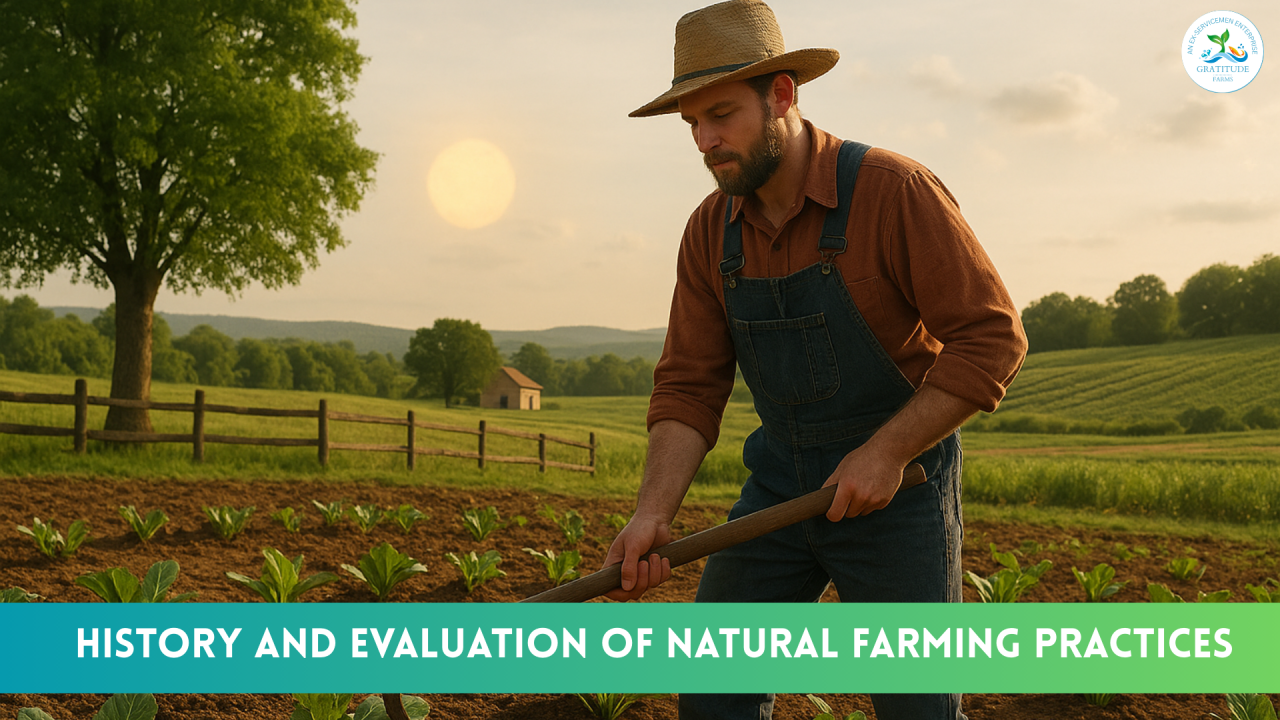
Ancient Roots of Natural Agriculture Natural farming is not a new invention. In fact, it predates modern industrial agriculture by thousands of years. Indigenous communities across Africa, Asia, and the Americas practiced organic and ecological farming methods, using compost, crop rotation, and livestock integration to maintain soil fertility and productivity. In ancient India, texts like the Vrikshayurveda (Science of Plants) detailed plant-based remedies, composting methods, and natural pest deterrents. In China and Japan, farmers practiced sustainable techniques such as mulching, cover cropping, and symbiotic planting.
Masanobu Fukuoka and the Modern Natural Farming Movement
The modern form of natural farming was popularized by Masanobu Fukuoka, a Japanese microbiologist and farmer. In the 1940s, he introduced the philosophy of “do-nothing farming”, where minimal human intervention is key. His method focused on:
1. No tilling
2. No fertilizers
3. No weeding by tillage or herbicides
4. No pesticides
5. No pruning
Fukuoka’s principles were revolutionary, emphasizing that nature is inherently capable of sustaining itself. His book, The One-Straw Revolution, became a foundational text for natural and permaculture farming worldwide.

The Rise of Conventional Farming and the Problems It Created
To appreciate natural farming’s relevance today, we must understand the problems caused by conventional farming, especially since the Green Revolution of the mid-20th century.
The Green Revolution:
A Double-Edged Sword The Green Revolution brought a massive increase in food production using high-yielding varieties (HYVs), chemical fertilizers, pesticides, and irrigation. While it addressed food scarcity in the short term, it led to:
1. Soil degradation due to overuse of synthetic fertilizers,
2. Water table depletion from intensive irrigation,
3. Loss of biodiversity due to monocultures,
4. Increased pest resistance from over-reliance on pesticides
5. Farmer debt and dependence on external inputs
These challenges have caused a resurgence of interest in natural and regenerative agriculture as a sustainable solution.
What is Natural Farming?
Key Principles and Practices Natural farming is based on the principle that agriculture should mimic natural ecosystems. It focuses on creating a self-sustaining, closed-loop system that supports soil life, plant health, and biodiversity.
Core Practices of Natural Farming
1. Zero Budget Natural Farming (ZBNF): Popularized by Indian agriculturist Subhash Palekar, this system involves no external inputs and promotes the use of homemade bio-inoculants like Jeevamrutha and Beejamrutha.
2. Mulching: Covering the soil with organic matter to conserve moisture and feed soil organisms.
3. Crop Rotation and Polyculture: Growing different types of crops in a field to reduce pest cycles and improve soil fertility.
4. Soil Microbial Management: Encouraging the growth of beneficial microbes to enhance soil nutrient availability.
5. Cow-Based Farming: Utilizing indigenous cow dung and urine for compost and pest repellents

Problem Solving: Can Natural Farming Feed the World?
Despite its benefits, many critics question whether natural farming can match the yields and scalability of conventional agriculture. Let’s evaluate the major challenges and explore solutions.
Problem 1: Lower Yields in the Initial Transition Period Challenge:
When shifting from chemical to natural farming, farmers often experience a drop in yield due to changes in soil biology.
Solution: This is a temporary phase. Research shows that after a few seasons, yields begin to recover as soil health improves. Farmer training, soil testing, and access to quality seeds can ease the transition.
Problem 2: Lack of Awareness and Training Challenge: Most farmers are unaware of the methods and benefits of natural farming.
Solution: Governments and NGOs should offer hands-on training programs, model farms, and online platforms for farmer-to-farmer learning. Digital agriculture and mobile apps can also play a critical role.
Problem 3: Market Access for Naturally Grown Produce Challenge:
Without proper certification, natural produce often fetches the same price as chemically-grown food.
Solution: Implement Participatory Guarantee Systems (PGS) and promote farmers’ markets, e-commerce platforms, and branding of natural produce to ensure fair pricing.
Problem 4: Policy and Institutional Support Challenge:
Most agricultural policies still favor industrial agriculture.
Solution: Policy reforms are needed to subsidize natural farming, provide incentives for soil conservation, and support research into regenerative techniques.

Benefits of Natural Farming
Despite challenges, natural farming offers multiple long-term benefits that cannot be overlooked:
1. Environmental Sustainability: It reduces greenhouse gas emissions, conserves water, and restores soil health.
2. Economic Resilience: Farmers reduce costs by eliminating synthetic inputs.
3. Health and Nutrition: Produce is free from harmful chemical residues.
4. Biodiversity Conservation: Encourages native seed use and preserves local ecosystems.
Case Studies and Success Stories
Andhra Pradesh, India:
The state has launched a large-scale natural farming initiative covering over 700,000 farmers under the Community Managed Natural Farming (CMNF) program.
South Korea: Traditional organic farming cooperatives have revived rural economies and gained international recognition.
Africa: Permaculture and agroecology initiatives in Kenya and Uganda are improving food security and resilience.
These examples demonstrate that natural farming is not just a theory, but a proven, scalable practice when supported correctly.
Conclusion: The Future Lies in Natural Farming
As the world faces increasing agricultural challenges from climate change to food insecurity the urgency to adopt sustainable, inclusive, and regenerative practices has never been greater. Natural farming offers a time-tested, ecologically sound alternative to chemical-intensive agriculture.
However, it requires systemic change in mindset, education, policy, and market dynamics. With proper training, incentives, and public awareness, natural farming can become a mainstream solution, not just for small farmers but for global agriculture at large.
Let us remember that farming is not just about producing food it’s about nurturing life, sustaining the Earth, and ensuring that future generations inherit a planet rich in diversity and abundance.

FAQs
Q1: What is the difference between organic and natural farming?
A1: While both avoid synthetic chemicals, natural farming is more restrictive and focuses on zero external inputs, whereas organic farming may use approved organic fertilizers and pesticides.
Q2: Is natural farming profitable?
A2: Yes, especially in the long term. Reduced input costs and access to premium markets can make natural farming economically viable.
Q3: How can I start natural farming at home?
A3: Begin with composting, mulching, and using native seeds. You can also attend workshops or follow natural farming communities online.